The Process Is the Product
Why the making of matters more than the made
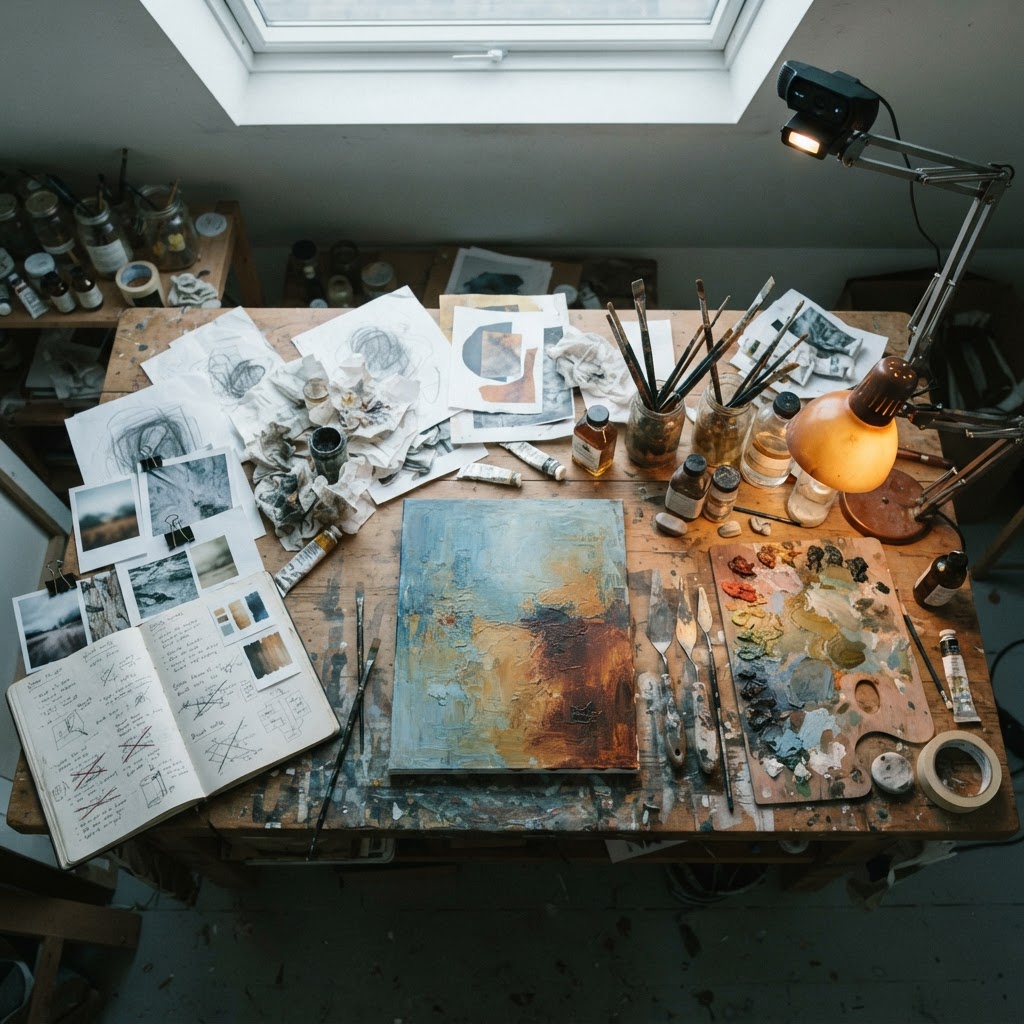
The Unorthodox Angle
In a world where AI can produce finished images in seconds, the finished object is no longer the proof of craft. The process is. The struggle, the revision, the wrong turns — that's what can't be faked. And that's what people want to see.
There was a time when the finished object was the only thing that mattered. The painting on the wall. The photograph in the frame. The pot on the shelf. The process that produced it was invisible — a series of private decisions that the audience never saw and wasn't invited to see.
Technology is changing that. The process is becoming the product. And it's happening faster than most people realize.
The Documentation Shift
ArtFlow Timelapse was built to solve a simple problem: artists working across multiple concurrent projects wanted to document their process without stopping to document their process. The solution was automatic — a webcam captures the work session, the system stitches timelapses, the artist gets a process video without doing anything differently.
What surprised me was how quickly the process video became more valuable than the finished piece in certain contexts. On social media, a timelapse of a painting being made gets more engagement than the painting itself. On a portfolio site, the process video communicates something the finished piece can't — that the artist knows what they're doing, that the work is made by a human hand, that there's skill behind the object.
In a world of AI-generated images, the process is proof. The timelapse is the receipt.
The Transparency Principle
I wrote about this earlier in "Building in Public" — the instinct to wait until something is done before sharing it is strong, and wrong. People connect with process, not perfection. When you build in public, you invite others into the journey.
What's changed since I wrote that piece is the scale of the AI-generated content problem. When anyone can type a prompt and produce a polished image, the question "did a human make this?" becomes urgent. And the answer isn't found in the finished object — it's found in the process.
The painting that took forty hours. The sculpture that went through seventeen versions. The photograph that required waking up at 4am to catch the light. These are stories. And stories are what people connect to.
The Data of Making
The DW8 Photography pipeline generates 30+ data points per photo — but those data points aren't just for search and SEO. They're a record of creative decisions. The camera model, the lens, the aperture, the shutter speed, the ISO, the focal length, the date taken, the GPS coordinates — this is the metadata of craft. It's the technical record of how the image was made.
When that data is attached to the photo, the photo becomes more than an image. It becomes a teaching moment. "This was shot at f/1, 1/125, ISO 800, with a 65mm lens on an X-T3." That's not a description — it's a recipe. And in a world where AI can generate images that look like photographs, the technical record of how a real photograph was made is the thing that makes it real.
The Studio as Content
This is the shift: the studio itself becomes content. The mess on the workbench. The reference images pinned to the wall. The test prints on the floor. The glaze notebook with its crossed-out recipes. These aren't behind-the-scenes extras — they're the main event.
Artists who understand this are already doing it. Ceramicists post their kiln openings on Instagram. Painters stream their work sessions on Twitch. Musicians release the stems and the session files alongside the finished track. The process isn't hidden anymore. It's the product.
And AI tools make it easier to capture. ArtFlow handles the timelapse automatically. The DW8 pipeline handles the metadata automatically. The studio assistant who never sleeps is also the studio documentarian who never stops recording.
The Teaching Dimension
There's a deeper reason the process matters: it's how craft gets transmitted.
The traditional model of craft education is apprenticeship — watching a master work, absorbing the decisions, learning through proximity. That model has been eroding for decades. What's replacing it, in part, is the documented process. The timelapse that shows every brushstroke. The metadata that reveals every technical decision. The process video that lets you see how someone who's good at this actually does it.
When the process is documented and shared, it becomes a teaching tool. Not a replacement for apprenticeship — but an expansion of it. Instead of one apprentice learning from one master, thousands of people can learn from the same process documentation. The craft doesn't get diluted. It gets distributed.
The Vulnerability Question
Showing the process means showing the failures. The wrong color choices. The compositions that didn't work. The hours spent on something that ended up being cut. There's vulnerability in that, and it's not for everyone.
But the vulnerability is the point. The finished object looks inevitable — like it was always going to turn out this way. The process reveals that it wasn't. The process shows the doubt, the revision, the wrong turns. And that's what makes it human.
AI-generated content looks inevitable because it is — the model produces the output in one pass, with no revisions and no doubt. The process of an AI generating an image is not interesting because there's no struggle in it. The process of a human making something is interesting because it's full of struggle.
When the process becomes the product, the struggle becomes the value.
What I'm Watching
I'm watching artists who grew up with social media start to treat their process as content naturally — not as marketing, but as the work itself. The finished piece is one output. The process video is another. The metadata record is another. The teaching moment is another. All of them are the work.
I'm also watching AI tools make process documentation cheaper and easier. When documenting the process costs nothing — when the camera runs automatically, when the metadata generates itself, when the timelapse stitches itself — the only reason not to share the process is vulnerability. And vulnerability, it turns out, is what people want to see.
The process is the product. The struggle is the value. And in a world where AI can produce finished objects in seconds, the record of how a human made something slowly is the thing that can't be faked.