The Expanded Vocabulary
How AI gives artists colors, patterns, and references they wouldn't have found
The Unorthodox Angle
Every artist works within a vocabulary bounded by what they've been exposed to. AI doesn't teach new techniques — it exposes artists to colors, patterns, references, and relationships they wouldn't have found. The vocabulary was always a limitation disguised as a style. AI removes the limitation.
Every artist works within a vocabulary. A painter has a palette of colors they gravitate toward. A photographer has compositions they default to. A musician has chord progressions that feel like home. A ceramicist has glaze combinations they trust.
These vocabularies are the product of experience — years of trial and error, of finding what works and sticking with it. They're also the product of limitation. You can only work with what you know. And what you know is bounded by what you've been exposed to.
AI expands the vocabulary. Not by teaching you new techniques — by exposing you to colors, patterns, references, and relationships you wouldn't have found on your own.
The Color Problem
Most artists work with the same handful of colors their entire career. Not because those are the only good colors — because those are the colors they know. The hex codes in every brand deck are the same five blues and grays. The paintings on the wall use the same palette the artist learned in school. The pottery glazes are the same six combinations that worked the first time.
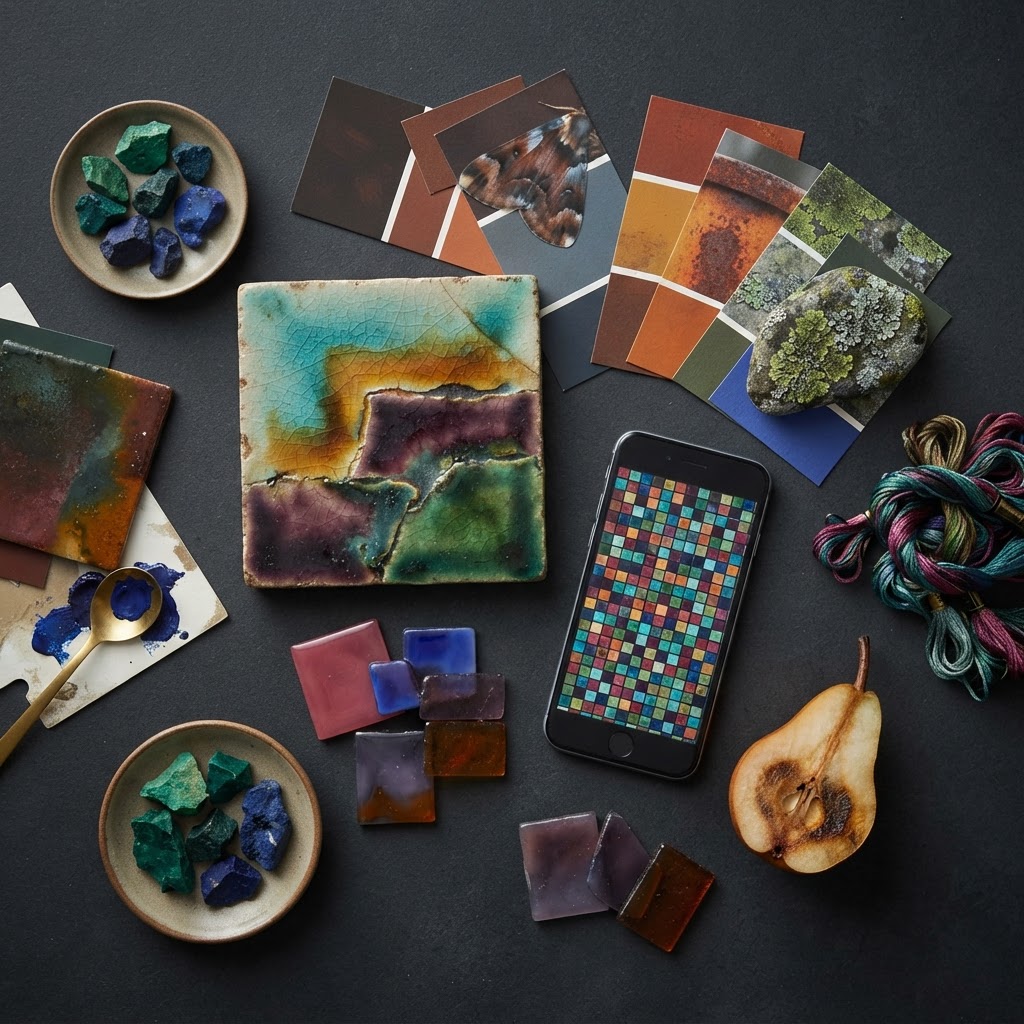
Color Collector was built to break this. Walk around. Take photos. The app pulls palettes from anything in the frame — a brick wall, a moth wing, a half-rotten fruit, a parking lot at dusk. The colors it finds aren't curated. They're extracted from the actual visual world, which contains infinitely more color relationships than any palette generator or color theory textbook.
The interesting palettes aren't the harmonious ones. They're the surprising ones — the colors that look wrong together until you see them in context. A rusted pipe against lichen-covered concrete. A faded carnival sign against a gray sky. The way a specific shade of pink makes a specific shade of green look different than it looks against anything else.
AI finds these relationships because it can see the whole scene at once and identify the dominant colors and their proportions. A human looking at a brick wall sees "red." The AI sees 72% muted terracotta, 18% gray mortar, 6% dark charcoal, 4% pale sage lichen. That's a palette. And it's not one you'd find in a color picker.
The Reference Problem
MUUZ solves a different version of the vocabulary problem. Most artists have a limited set of visual references they draw from — the museums they've visited, the books they own, the Instagram feeds they follow. The universe of art they haven't seen is infinitely larger than the universe they have.
MUUZ pulls from museum collections and learns what you respond to. It doesn't generate new art — it surfaces existing art you wouldn't have found. The longer you use it, the better it knows your taste. The better it knows your taste, the more targeted the references become.
This is different from a recommendation engine. A recommendation engine shows you more of what you already like. MUUZ is trying to show you work that will expand your vocabulary — work that's adjacent to what you respond to but different enough to push your boundaries. The goal isn't to confirm your taste. It's to grow it.
The Pattern Problem
Mosaica takes a photo and generates a mosaic pattern — not as a finished product, but as a fabrication reference. The artist chooses the tile material (ceramic, glass, stone), the piece size, and the color variation. The AI generates a pattern that can be fabricated.
What's interesting is what the AI sees that the human might not. The pattern it generates isn't just a pixelated version of the photo. It's a translation of the photo's color and tonal relationships into a new medium. The AI understands that a mosaic is not a photograph — it's a collection of discrete units with gaps and grout lines and material properties. The pattern accounts for that.
This is vocabulary expansion in a literal sense. The artist who has only worked with geometric mosaic patterns now has a tool that can generate organic, painterly, or abstract patterns from any source image. The menu of what's possible just expanded by an order of magnitude.
The DW8 Photography Example
The photography pipeline I built for DW8 Photography does something similar with metadata. The AI generates mood descriptors ("serene," "moody," "nostalgic," "dreamy"), composition analysis ("close-up," "shallow depth of field," "bokeh," "soft focus"), and color names ("muted purple," "sage green," "olive green," "warm gold") for every photo.
These aren't just tags for search. They're a vocabulary for understanding your own work. When you can search your entire archive for "dreamy" photos and see every image you've ever made that the AI identified as dreamy, you start to see patterns in your own seeing. You discover that you've been drawn to a specific quality of light for years without naming it. The vocabulary the AI provides becomes a mirror for the artist's own tendencies.
Beyond the Visual
The vocabulary expansion pattern applies to every creative discipline:
Music. AI can analyze harmonic relationships across genres and traditions that most composers never encounter. A Western-trained composer working in major and minor keys can be exposed to microtonal scales, non-Western tuning systems, and harmonic structures from traditions they've never studied. Not to appropriate them — to expand the harmonic vocabulary available to their own ear.
Ceramics. AI can predict glaze interactions across thousands of combinations that would take a lifetime to test. The potter who knows six reliable glaze recipes can access a database of predicted outcomes for combinations they've never tried. The vocabulary of possible surfaces expands from dozens to thousands.
Textiles. AI can generate pattern variations that a weaver would never arrive at through traditional drafting. By analyzing structural relationships in existing patterns and generating novel combinations, the tool expands the menu of what's possible on the loom. The weaver's pattern vocabulary grows without requiring years of additional training.
Writing. AI can surface structural patterns from literary traditions the writer hasn't read. Not to write the story — but to suggest narrative structures, pacing patterns, or point-of-view approaches that the writer's reading history wouldn't have exposed them to. The structural vocabulary expands.
The Risk
Vocabulary expansion has a risk: the McDonald's problem. When you can get any food from anywhere in the world delivered in thirty minutes, the constraint that used to produce local cuisine disappears. Everything becomes everything. The distinctiveness that came from limitation gets flattened.
The same can happen with creative vocabulary. If you can access every color, every pattern, every reference, every harmonic tradition, the work can become a generic average of all influences. The vocabulary expands but the voice dilutes.
The defense against this is intention. The expanded vocabulary is a menu, not a mandate. The artist still chooses. The AI provides more options; the artist provides the taste. The expanded vocabulary gives you more to choose from, but the choosing is still the work.
And that's the point. The vocabulary was always a limitation disguised as a style. AI doesn't remove the style — it removes the limitation. What you do with the expanded palette is still entirely up to you.